Feb 06, 2026
10 Ways PhycoTerra® is a Unique Input in the Agricultural Space
Read More



March 30, 2026
American farmers have navigated volatile fertilizer markets before. The Russian invasion of Ukraine in 2022, Chinese export restrictions, supply chain disruptions. But what’s unfolding in spring 2026 is hitting at the worst possible time.
If it was fall, farmers would have time to adjust. But the shortage is taking place during spring planting season, the narrow window when fertilizer decisions are made, purchased, and applied. Miss this window, and there’s no making it up.
If you’re planning on applying fertilizer, it has to go further than ever before to cushion the bottom line. To do that, your soil microbiology has to be abundant, active and diverse. Without a consistent food source, there’s a good chance it isn’t, and you’re leaving money in your soil.
The Strait of Hormuz is one of the most critical channels in global agricultural supply chains. Around 30% of all internationally traded fertilizers flow through the Strait, including 30 to 35% of global urea exports and 20% to 30% of ammonia exports. Since the U.S.-Israeli strikes on Iran began on February 28, shipping traffic through the Strait has fallen from around 130 ships per day to single digits, a decline of more than 95%.
Spring planting is perhaps the least ideal window for fertilizer to become so scarce. Without enough fertilizer, crop yields could decline. Couple that with unexpected weather, and all the chips are stacked against farmers this year.
The price data confirms the severity. Urea rose from $450+ per ton on February 27 to over $700 per ton by mid-March, an increase of roughly 50% in under three weeks. And even before the Iran conflict, the cost of nitrogenous fertilizer had already risen 22% from February 2025 to February 2026, according to the Bureau of Labor Statistics.
This isn’t a short-term blip. Unlike oil, there are no strategic reserves for fertilizer, putting the sector at a comparative disadvantage when supply is disrupted.
Here’s what makes this crisis particularly acute for American farmers: fertilizer was already working against them before any of this happened.
Research published in Frontiers in Plant Science shows that globally, crops use only about 50% of applied nitrogen effectively. The rest is lost through volatilization, leaching, runoff, and denitrification. Phosphorus binds to soil particles in a process called fixation, locking it in forms roots can’t access. Potassium leaches below the root zone under heavy rainfall or in sandy, low-organic-matter soils.
While synthetic fertilizers have helped farmers produce more than ever, it still has a significant gap to be addressed. For example, there’s still an opportunity when it comes to the fertilizer use efficiency and making the cost of fertilizer have more economic return.
Since 2020, fertilizer has accounted for 33% to 44% of corn operating costs and 34% to 45% of wheat operating costs, according to USDA Economic Research Service data. Illinois corn farmers are projected to spend approximately $229 per acre on fertilizer in 2026. At those rates, losing half of applied nitrogen is not only an efficiency problem – it’s a profitability crisis, and the Iran conflict has just made it significantly more urgent.
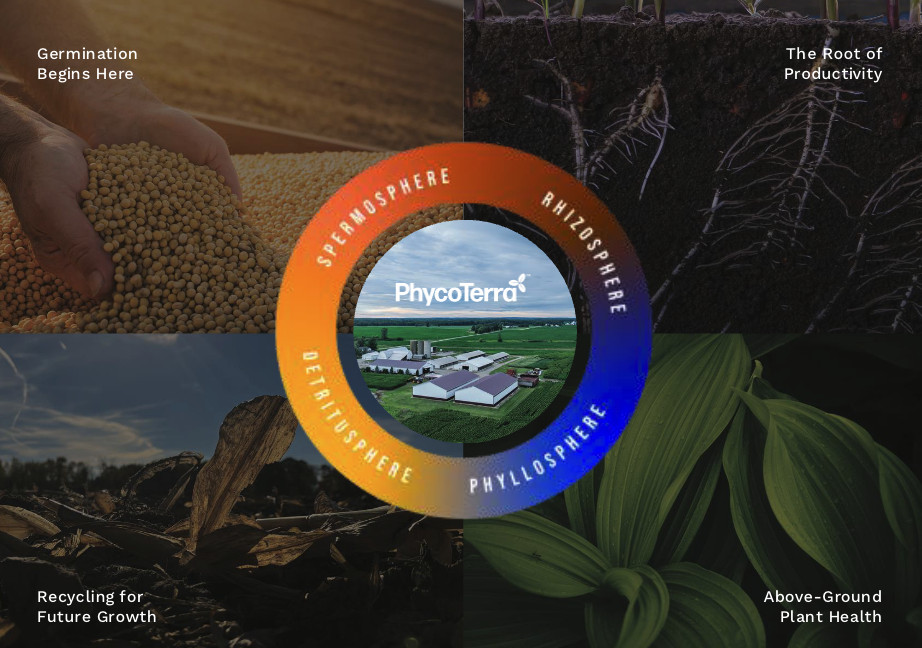
The common thread across all of these losses is soil biology. Without an active microbial community in the rhizosphere, the zone of soil surrounding plant roots, the conversion of applied fertilizer into plant-available nutrients stalls. Research published in Nature Communications confirms that soil organic carbon is the strongest predictor of microbial nutrient use efficiency, with higher carbon content directly associated with greater efficiency across nitrogen, phosphorus, and potassium.
On most farm soils, where organic carbon is depleted and 75% of microbes are inactive, that biological engine is running at a fraction of its capacity.
PhycoTerra Soil Amendment is not a fertilizer. It does not replace a fertility program. What it does is activate the native soil biology responsible for maximizing fertilizer. It feeds the bacteria and fungi in the rhizosphere that convert applied N, P, and K into plant-available forms, retain nutrients in the root zone, and support stronger root development and more consistent uptake.
In practical terms, that means more of the fertilizer you’ve already purchased actually reaches your crop. In a season when every input dollar is under pressure, that’s one of the clearest efficiency opportunities available.
This game plan, of feeding microbiology and getting more out of existing fertilizer, has worked for other farmers.
Illinois corn farmer Marshall Brown ran a soil test and found nutrients were tied up and unavailable despite a full fertility program. After adding PhycoTerra to his operation, he yielded an extra 16 bu/acre in 2024, and an additional 3.5 bu/acre in 2025 despite drought conditions. Most farmers see an ROI of up to 4.5x their initial PhycoTerra investment.
DOWNLOAD THE FREE BROWN FARMS CASE STUDY HERE
PhycoTerra is compatible with existing fertility programs and requires no additional passes. It tank-mixes with fertilizer and crop protection products at application, adding no complexity to a program that’s already demanding more of farmers this spring.
USDA projects 2026 average prices of $4.20 per bushel for corn, $10.30 for soybeans, and $5.00 for wheat, all below estimated national average break-even prices, suggesting continued margin pressure for many producers.
Analysts say hopes for meaningful relief on fertilizer affordability are fading, with high input prices and poor affordability expected through most of 2026 and even into the third and fourth quarters. The fertilizer disruption driven by the Iran conflict adds a new layer of uncertainty on top of a market that was already strained.
In this environment, farmers can’t control what fertilizer costs. They can’t control the Strait of Hormuz or Chinese export policy or the price of natural gas. What they can control is how much of the fertility investment they’ve already made actually reaches the plant.
That’s exactly what PhycoTerra is designed to do. Feed the biology. Protect the investment. Farm Forever.
To help farmers make the most of every growing season, PhycoTerra is proud to present Field Notes – timely insights for real decisions in the field. Our most recent Field Note: Fertilizer Edition covers everything you need to know about the fertilizer efficiency gap, and how PhycoTerra helps more of what you apply to actually get to the plant. Practical, science-backed, and less than five minutes to read.
Preserving the Future of Farming

Learn more about our mission to keep farming economically and ecologically sustainable.
Learn More